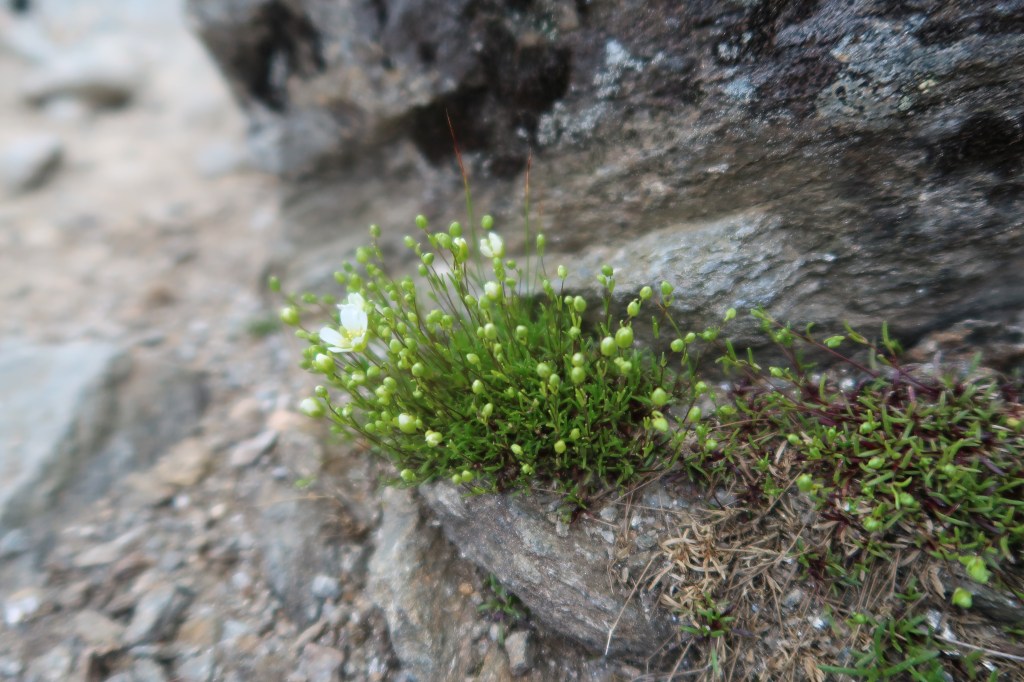
It was a cool, late June day in Conway, New Hampshire. The day’s High was in the 90s, but it was chilly enough that morning that I needed a jacket. My husband and I had an early start that morning and drove to the Ammonoosuc Ravine Trail head of Mt. Washington, the tallest mountain in New England.
About two, maybe three hours later, we were out of snacks, and almost out of water.
“There’s soup at the Lake of the Clouds Hut. It’s only about two hours from here,” another hiker told us.
The thought of soup kept me going.
When we got to the Hut, there was no soup. Instead, I drank enough water to feel a bit sick and ate a brownie. At least they had some food at the Hut, even though they didn’t have soup.
They also had stickers. I’m a sucker for those and bought several.
Eventually, we had to leave the Hut and continue onwards towards the summit. Along the way, we met someone hiking the entire Appalachian Trail. He had started down in Georgia some months back, and his shoes had a fiery pattern to them. They reminded me of Guy Fieri’s flame shirt.
“I heard they have mac and cheese at the summit,” the hiker with the flame shoes said.
The thought of mac and cheese kept me going.
Imagine my disappointment when there wasn’t any.
But there was something far more interesting than soup and mac and cheese on the peak of Mt Washington.
***
The plant Potentilla robbinsiana grows only in the alpine regions of Mt Washington. It grows to the size of a US quarter so it’s easy to miss, and its small size belies a massive success story of conservation.
The plant’s main habitat is the Monroe Flats, and in the early 1800s, Abel and Ethan Allen Crawford built the Crawford Path to the summit of Mt Washington–and the path went right through the Monroe Flats. Since the plants are so small, they were easily trampled and killed by hikers.
The plant was also popular with plant poachers, who ripped them up to sell them or keep for themselves.
By 1973, fewer than 2,000 flowering adult plants were left. The plant was endangered, and it would be a project to change that.
It was a team effort between the U.S. Fish and Wildlife Service which managed the project and worked with everyone; The Appalachian Mountain Club which rerouted trails, educated the public, and researched Potentilla robbinsiana; and The New England Wild Flower Society which focused on growing Potentilla robbinsiana in greenhouses and transplanting them back to their native habitat. The Forest Service and scientists from the University of New Hampshire also contributed to the effort.
By 1999, there were over 4,500 adult flowering plants, and in 2002, Potentilla robbinsiana was the first plant ever to be taken off the endangered species list.
Today, the trail to the summit is clearly marked and groomed for hikers. Signs warn about the mercurial weather of the summit and remind hikers to stay on the trails. After all, the trails are safer–for both hikers and wildlife alike.
Like my posts and art? Be sure to subscribe!
Further Reading:
Dwarf cinquefoil, from the Center of Biological Diversity
Tiny and Triumphant, from Be Outdoors
Recovery of Robbins’ Cinquefoil, from the US Forest Service
 MAC and Brie Make
Leave a comment